|
Joe
Lee, architect of the Hampton Club on St. Simons Island, is in golf
circles often a forgotten man, and the circumstances surrounding his
career are to blame for that. As an apprentice under Dick Wilson, whose
prolificness and excellence in the 1950s and 1960s was rivalled only by
that of Robert Trent Jones Sr., Lee was often the talent behind the
recognizable name. Wilson gets credit for some lauded original work at
Doral and Royal Montreal,
when it was Lee's vision that was the inspiration for these courses. In a
profession where ego and self-promotion are commonplace, Lee was a modest
anomaly. As his mentor battled alcoholism late in his career, Lee ran the
practice under Wilson's recognizable name, and only recently have course
such as Cog Hill, and Callaway Gardens been rightly attributed to
his talents. When Lee passed away recently at the age of 80, with a
variety of projects still coming to fruition, golf architecture lost one
of the game's most unique and understated visionaries.
At
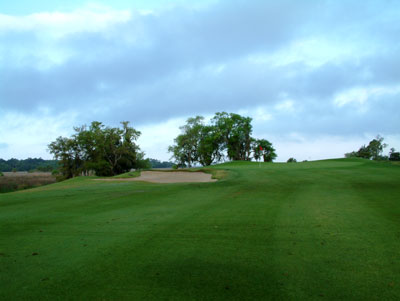
the Hampton Club, Joe Lee's fingerprints can be found everywhere. Designed
on a low-profile site
among the salt marshes and sweeping oaks on St. Simons Island, changes in
elevation are basically non-existent. Lee was charged with the task of
using subtle, strategic bunkering and the natural presence of foliage and
marsh to create a challenging yet playable course. Lee has gone on record
saying that the objective at the Hampton Club was not to try and make
'signature holes' at every turn, and the uncomplicated 368-yard opener
sets off a succession of strong, no-frills golf holes. The green at the
first is open in front, allowing players to run the ball on easily.
At
the longer par-four second, one begins to get a sense of the natural
rhythms Lee seems to emphasize in his designs. The Hampton Club features
stretches of holes that build to exciting climaxes. One and two are benign
par fours that delve deeper into the marshland, until players reach the
green at the 570-yard third, where the green sits precariously close to
the hazard and carries the scent of the sea.
Without the shelter of trees, wind can play havoc with approaches here,
but again an opening in front makes a running shot the prudent play.
A
stretch of holes brings the round inland from the cape, and at the
172-yard seventh, players find themselves ensconced in rife coastal
vegetation. The ocean could be miles away now. Despite the moderate length
at seven, a tricky green complex makes this a challenging hole. Shots
missed to the left will likely find a shallow bunker, while misses right
will find a hollow, from where players must carry a clearly defined ridge
playing back up to the green.
An
inland pond is the perilous hazard on the closing hole on the front side,
a 365-yard par four that doglegs left around the water. Lee dares players
to play the driver close to the hazard for a second shot, and even assists
in framing the shot with a stand of trees on the water's edge that helps
to define the target line. Even a perfect tee shot leaves a short iron
that must be struck decisively. A three is very possible here, but so too
is six or worse.
When
Lee was assessing the land he had been given for the Hampton Club back in
the spring of 1988, he grew fraught with concerns. The layout he had
envisioned might be too ambitious for the available land, so it's somewhat
ironic that much of The Hampton Club's reputation stands on a four-hole
stretch that was not even part of the original course plans. Long wooden
causeways lead players as they island-hop through a marsh-bound
archipelago from the 11th green to the 15th, a unique series of holes fit
into a tiny parcel of land. 11 demands a true tee shot that splits the oak
stands, leaving a short iron to a green flanked by two bunkers and the
wide marsh on the right. The broad view of the bayou behind the green can
cause perception problems on the approach, so players must trust their
yardage.
12
is little more than a pitch shot, but one that can be easily complicated.
Anything in the middle of the green should ensure par, but trouble
surrounds the green should the golfer flinch.
13
is likely the most challenging par four at the Hampton Club. The tee shot
must be struck boldly down a channel banked by marsh on either side, and
the approach is to a slightly elevated green positioned at one of the
farthest fringes on the Eastern seaboard. Those wary of playing their
shots long may find their approaches repelled by a false front.
At
the 461-yard 14th, players can give themselves an eagle chance if they
choose a bold line on their tee shot and play aggressively down the
left-hand side. This opens up the green for a long approach to a thin
green.
With
just a fraction of land left, Lee managed to squeeze in the 155-yard 15th,
framed by a series of bunkers that are both punitive and aesthetically
deceptive. Take an extra club to avoid their draw, and emerge from this
fine stretch at The Hampton Club with momentum for the closing holes,
which provide one last challenge.
The 17th is arguably the hardest hole on the course,
measuring 430 yards from the blue markers and playing potentially longer
on this dogleg right. The oak trees that line the hole are seemingly
always in play, and while bunkers loom, the generous width of the
fairway means that two
well-struck shots should find the putting surface.
The
closing hole, on the other hand, provides perhaps not as brutal a test as
its predecessor, but adds some excitement with a good chance for a closing
birdie. At
505 yards, the hole is reachable to the long hitter, but the tee shot must
fly straight through a chute of oaks to the fairway. From there, a pond
and lone tree guard the right side of the green, but without a perfect
drive, laying up is the wise and prudent option.
Hampton
Club is a suitable tribute to the style of the late Joe Lee; subtle and challenging
while still being enjoyable. The course makes its
indelible mark with the stretch of marsh holes, but Lee’s balance, both
leading up to and after the marsh, show the complete nature of the course
as an overall event rather than a series of highlights.
The Hampton Club lives on as a destination for the golf traveler, who
would like to combine the idyllic setting of St. Simons Island and golf
into one trip.
|