The
setting, along the shores of the Pacific Ocean, is
both breathtaking and dramatic. The elements of
the drama come in many forms, but perhaps most
noteworthy is the wind which, coming off the water,
can be as gentle as a breeze or as vicious as a
gale. Many have charged that American golf lacks
the winds that the Scots consider so essential to the
game. Yet Pebble's rare oceanfront setting
provides powerful winds that rival those of any course
in any country. While many golfers are familiar
with the par five finishing hole that bends around the
ocean, the 17th hole that yielded Watson's chip in to
defeat Nicklaus in 1982, or the famous seventh where
Tom Kite holed out for birdie en route to the 1992
U.S. Open title, Pebble has much more in its
repertoire than merely a select number of signature
holes.
The
first two holes may lack the drama of the finishing
stretch, but certainly help to work the golfer into
his round. Players should take advantage of the
short par five second, because it presents the best
birdie opportunity on the front nine.
One
gets the first sense of the true Pebble Beach upon
arrival at the third tee. The sharp dogleg par
four sweeps down and to the left, exposing the golfer
to the Pacific Ocean behind the small green. The
approach - generally with a mid to short iron - to
this tabletop green which falls off on all sides,
leaves a devilish chip if missed. A play to the
center of the green should give the golfer a
reasonable chance at par, but that is easier
said than done.
The
fourth and fifth holes turn south along the ocean;
both these short holes are scenic and strategic.
The fourth requires a well-placed tee shot and a short
approach below the hole. The fifth is one of the
more interesting stories in modern golf
architecture. Until 1999, the hole occupied a
blind, uphill piece of land, and was considered a weak
link in the layout. When the Pebble Beach
Company purchased the oceanside land adjacent to
Stillwater Cove, they called on Jack Nicklaus - 1972
U.S. Open champion at Pebble - to design a new par
three, which Golf Digest has said contributed to
Pebble's bumping of Pine Valley from top spot on its
most recent Top 100 rankings. This new hole is a
medium-length par three that hugs the cliff and
requires a fade - either along the ground or in the
air - to get close to the pin. Five is now the
beginning of the most famous stretch of oceanside
holes in golf.
Continuing
along this run of wonderful holes, the par five sixth
is remarkably different from the images captured on
television. The elevation change from the green
relative to the fairway is incredible, moving steeply
uphill along the cliffs of the Pacific. A strong
drive down the fairway leaves one with a lay-up that
must be struck long and high to carry to the next
plateau. From there the golfer faces a short
approach that is made difficult by the ocean behind
the green, which can throw off focus and depth
perception.
Pebble
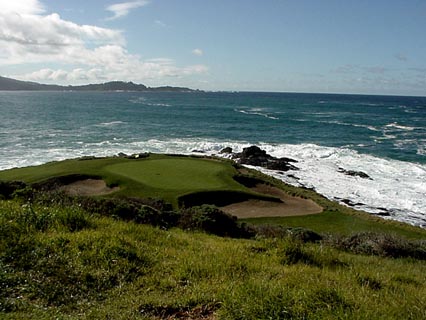
Beach truly begins to bare its teeth at the seventh
hole. Most serious golfers can identify this
hole from its photograph, and it may be the most
famous short par three in the world. Stretching
only 106 yards, the hole demands from a 3 iron to a
wedge depending on wind direction. The green is
diminutive, which translates into a relatively short
birdie putt if the tee shot is properly negotiated.
After
the spectacular seventh, the view from the eighth tee
does not give a true appreciation of this next
hole. The blind tee shot is over the marker
stone, and from there the drama of the hole
unfolds. Nicklaus has called this his
"favourite second shot in golf" because it
plays from an elevated fairway over the Pacific Ocean
to the green below. The green is small and
heavily sloped, which means that long iron approaches
have difficulty settling close to the hole.
If
eight begins the famed "Cliffs of Doom"
holes, nine and ten are equally difficult. The
466-yard ninth is a grueling par four that will test
any golfer. The ocean is a distraction, running
the length of the right side, and can come into
play if the approach shot drifts to the right.
10
is the last Oceanside hole before the 18th, and while
the ocean provides a backdrop, it really should not be
a factor. The highlight of the hole is the view
down the beautiful beach towards Big Sur. The
course turns inland at eleven, beginning a series of
holes often called the "Achilles Heel" of
Pebble Beach, but there is a good mixture of quality
golf holes in the stretch.
13
has an ultra-challenging green for a first-time
player. 14 is a long par five, and a pin cut on
the left side of the green takes away virtually any
chance of a birdie. The par four 15th, where
Tiger made an eagle two in his comeback over Matt
Gogel in the 2001 AT&T Pro-Am, is the easiest hole
coming in and offers a good birdie opportunity.
16,
which begins Pebble's trek back toward the Pacific for
the finale, has lost a bit of its mettle.
Technology has rendered the highly original bunker in
the centre of the fairway virtually obsolete, but this
hole's strategic key is still in play for the shorter
hitter. The best angle is to the left side of
the fairway, offering an unobstructed approach to another small and undulating green.
The
17th hole is a testy par three, especially if the wind
is blowing into a player's face (as it often
does.) The hourglass green is another Pebble
trademark, though the seven bunkers - including the
massive front bunker - are equally notable. From
208 yards, a pin in the back left is virtually
impossible to attack, making both Jack Nicklaus' 1
iron off the flagstick in 1972 and Watson's birdie
chip in from the nearside long rough in 1982 all the
more remarkable.
The
walk up 18 must surely be one of the most cherished
moments in American golf. The dogleg 543-yard
par five literally bends around the Pacific, with
out-of-bounds guarding the right side. The
previously unreachable par five now offers a variety
of strategic options for the good golfer who can
threaten the green with his second shot. With
the tree that stood guard on the right side of the
fairway now gone, there is more room for the long
hitter to play a strong draw into this green.
This beautiful closing hole, which many call the best
finisher in the game, is simply an experience to
behold.
Many
musings of amateurs playing Pebble for the first time
relate to the small greens, which require pinpoint
control to leave the ball below the hole. The
dramatic elevation changes, which television cameras
can never capture, especially on the uphill holes,
provide extra length and reward strategic play.
All of this simply reinforces the mantra that you
don't know a course until you've seen it
first-hand. No matter how familiar we are with
this course from golf history, its rugged beauty has
to be seen to be truly appreciated. Pebble Beach
has persevered through the years and is now the best
public course in the United States, and quite possible
the best public course in the world.